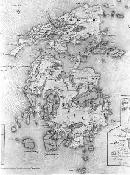
The Vinalhaven Historical Society is located on unceded Wabanaki territory now known as Vinalhaven, Maine. The first known inhabitants to discover the rich abundance of shell and fin fish in the islands' waters were the Red Paint people, so named for their use of ochre in burial rituals and shell middens later discovered by colonial explorers and settlers. First Nations peoples traveled here during the summers to fish and hunt roughly 3800 to 5000 years ago and they hold ancestral ties to the Wabanaki Confederacy (translated to "People of the Dawnland") who have lived and tended to these lands for over 12,000 years. The Wabanaki Confederacy today includes five principal Eastern Algonquin nations: the Abenaki of St. Francis, Mi'kmaq, Maliseet, Passamaquoddy and Penobscot.
European colonial explorers started visiting these waters between the 1400s and 1600s. The English Captain Martin Pring is said to have sighted the islands and named them The Fox Islands in the early 1600s. Permanent settlement by English colonists did not take place until after cessation of the French and Indian Wars in 1763. According to a petition to King George III, dated 1772, Thaddeus Carver arrived from Marshfield, MA in 1762 and by 1775 he was operating a saw mill on 700 acres purchased from Francis Cogswell on the southern shore of what later became known as Carver's Harbor, Vinalhaven, Maine. It is estimated that during these centuries (1400-1800) up to 95% of First Nations people along the east coast were lost to conflict, disease, and forced displacement.
|
After the Revolutionary War the population of the islands grew rapidly. In 1785 seventy-five settlers petitioned the General Court of Massachusetts "to relinquish any claims that this Commonwealth may have to said Islands, to all inhabitants and their Heirs and Assigns forever..." The attorney representing the islanders at the Court was a Bostonian John Vinal, Esq. and the islands were named for him (though not by the request of the inhabitants. It is also not known if he ever stepped foot on the island.) Among the first settlers were the families of Arey, Carver, Calderwood, Coombs, Dyer, Ginn, Green, Hopkins, Lane, Leadbetter, Norton, Philbrook, Pierce, Roberts, Smith, and Vinal. By 1800 the population was 860 on both islands. In 1846 the North Island was "set off" to become North Haven. The population of the South Island, Vinalhaven, reached its peak of 2855 in 1880.
|
The early occupations were fishing, farming, logging, boat building and, for women, the knitting of fish nets and thousands of horse nets sold to protect horses from flies. By 1826 the quality of Vinalhaven's granite was discovered and the island's 100 year period as one of Maine's largest quarrying centers began. Men arrived from other states, from the British Isles and from Scandinavia to work. Hundreds of men quarried, cut, polished, carved and shaped many tons of granite. Stone left the island on sloops, schooners and barges for ports as far away as Pensacola and New Orleans.
The first large Federal contracts were for granite blocks to reinforce the gun platforms at Forts along the Atlantic and Gulf coasts prior to the Civil War. Granite was shipped for:
- the base of the Brooklyn Bridge
- the U.S. Customs House and Post Offices in New York, St. Louis, Kansas City, Buffalo, etc.
- the Railroad Station and the Board of Trade in Chicago
- the Washington Monument and Federal Offices Buildings in the Capital
- formed the foundation stone and the eight huge polished columns for the nave of The Cathedral of Saint John The Divine in NYC
- Pennsylvania Railroad Station and the Masonic Temple in Philadelphia
- other private mansions, monuments, bridges, and dams
- thousands of tons of paving blocks for the streets of Portland, Boston, New York, Newark, Philadelphia and other cities
With the introduction of structural steel and concrete as building materials the largest granite company closed in 1919. The paving block industry continued until the late 1930s.
The sea also has been of great importance to Vinalhaven's economy as the island has always been a major supplier of seafood to markets in Portland, Boston and New York; first as salted and dried fish, then canned lobster, canned fish, fish glue, cut and packed fresh fin fish, canned herring, fresh lobsters, scallops, shrimp and sea urchins. During the 1800s and into the mid-1900s the island had a large fleet of fishing vessels, some bringing home catches of 10,000 lbs. or more.
|
Vinalhaven or Vinal Haven?
Originally one word in 1789. The U.S. Postal Service changed the Post Office's name from South Vinalhaven to Carver's Harbor (1850), to Vinal Haven on October 29, 1879 and back to Vinalhaven on March 15, 1925.
|
|